ChatGPT Ads: A New Advertising Channel for Businesses?
Google Ads reaches people who are actively searching. Social ads reach audiences based on interests, profiles and behavior. With ChatGPT Ads, another advertising channel is emerging: businesses can reach potential customers while they are researching topics, comparing options and preparing decisions within ChatGPT.
This makes advertising in ChatGPT particularly interesting for complex products and services that require explanation. At the same time, the channel is still relatively new. Businesses should therefore view ChatGPT Ads neither as a short-term replacement for established performance marketing channels nor as an automatic growth driver. Success will still depend on whether the offer, target audience, messaging, landing page and measurement strategy work together.
What Are ChatGPT Ads?
ChatGPT Ads are paid advertisements displayed within ChatGPT. OpenAI began testing ads in the United States in February 2026 and subsequently expanded availability to additional markets. Since late August 2026, self-service access to the Ads Manager has also been available in Germany. The Ads Manager remains in beta.
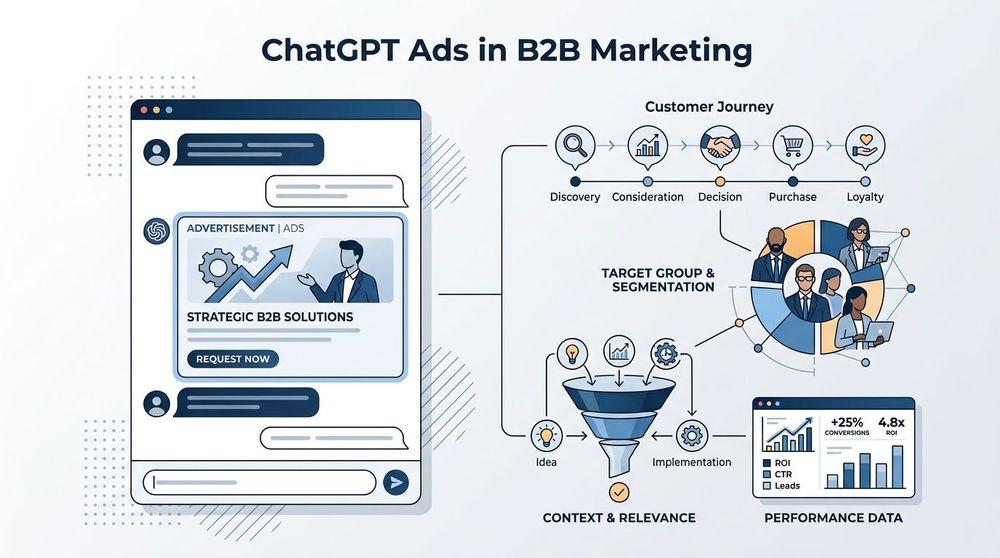
Ads appear below ChatGPT responses, are clearly labeled as sponsored and are separated from the actual answer. According to OpenAI, advertisers cannot influence the answers ChatGPT provides. Ads can currently be shown to users on certain plans, including Free and Go, while Plus, Pro, Business, Enterprise and Edu remain ad-free.
For advertisers, the way ads are matched to users is particularly relevant. Instead of focusing solely on individual search terms, the system considers several relevance signals. These include the context and intent of the current conversation, the content of the ad and landing page, and contextual guidance provided by the advertiser. This guidance does not work like traditional exact-match keywords and does not guarantee placement in specific conversations.
Why Could ChatGPT Be an Interesting Advertising Environment?
The key difference is not simply the ad format, but the context in which people use ChatGPT. Users often do more than enter a short search query. They describe problems, specify requirements, compare alternatives and ask for explanations of complex topics.
This can create an interesting environment for advertisers. A potential customer may not simply search for “ERP software”, for example, but instead explore which type of ERP solution would suit a mid-sized manufacturing company with specific processes and requirements. The conversation can therefore reveal considerably more about the user's current problem than a single keyword.
However, this does not automatically translate into higher conversion rates. It simply creates another opportunity to reach potential customers in a relevant context.
ChatGPT Ads vs. Google Ads and Social Ads
ChatGPT Ads do not replace existing advertising channels. They address a different usage situation and potentially a different stage of the customer journey.
- Google Ads: Particularly effective when users already have a concrete search intent. Keywords are an important basis for targeting and campaign structure.
- Social Ads: Can generate demand and reach target audiences even when they are not actively searching for a solution. Audience, interest and behavioral signals play an important role.
- ChatGPT Ads: Can become relevant during more extensive research, comparison and decision-making processes. The context of the conversation is an important signal for ad delivery.
From a marketing perspective, the key question is therefore not “Which channel is better?” A more useful question is: Which channel can contribute at which stage of the customer journey?
Why ChatGPT Ads Could Be Relevant for B2B Companies
B2B purchasing decisions are often complex. Consulting services, software platforms, machinery or specialized business solutions cannot usually be explained with a product image and a discount. Potential customers first need to understand their problem, evaluate possible approaches and determine which solution fits their specific situation.
This is where ChatGPT Ads could become particularly relevant. The channel may be worth exploring for SaaS providers, IT service companies, consultancies, industrial businesses and providers of specialized B2B solutions – especially when prospective customers conduct extensive research before contacting a vendor.
OpenAI currently supports both CPC- and CPM-based campaigns. The Ads Manager provides metrics including impressions, clicks, click-through rate, average CPC, CPM and conversions. This gives businesses a foundation for testing and evaluating campaigns rather than treating the channel purely as an awareness measure.
What Are the Limitations and Challenges?
One of the main limitations is the relatively limited amount of historical campaign data. Most companies have significantly more experience with Google Ads, LinkedIn Ads or other established platforms. Benchmarks from those channels cannot simply be transferred to ChatGPT Ads.
Another limitation is reach. Not every ChatGPT user sees advertising, as certain paid plans remain ad-free. Advertisers also cannot control delivery in exactly the same way as with a traditional keyword campaign. OpenAI explicitly states that contextual guidance does not guarantee that an ad will appear in a particular conversation.
For B2B companies, there is another familiar challenge: a click is not necessarily a qualified lead. When sales cycles are long, companies need to evaluate what kind of leads the channel generates and what commercial value those leads ultimately create.
What Should Companies Have in Place Before Testing ChatGPT Ads?
A meaningful test should not start with campaign creation. Four fundamentals should be addressed first.
1. A Clear Understanding of the Target Audience and Its Problems
Companies should understand the situations, questions and decision-making challenges that lead potential customers to their offering. Broad definitions such as “decision-makers at mid-sized companies” are rarely specific enough.
2. Clear Positioning
If an ad and landing page do not quickly communicate who the offer is for, which problem it solves and what makes it relevant, a new advertising platform will not compensate for weak positioning.
3. Landing Pages That Match User Intent
A user who has just completed an in-depth research process in ChatGPT may expect more than a generic landing page with a short headline and contact form. Complex B2B offerings need pages that answer relevant questions, build trust and provide a logical next step.
This makes landing page quality particularly important. Messaging, information depth and conversion paths should match the context in which users arrive.
4. Reliable Tracking Before Campaign Launch
OpenAI provides conversion measurement through the OpenAI Pixel and Conversions API. UTM parameters can also be used to identify and analyze ChatGPT traffic within existing analytics environments.
Businesses should define meaningful conversions before launching campaigns. For B2B companies, this may include qualified enquiries, demo requests or registrations rather than simply measuring page views and clicks.
How Can Businesses Test ChatGPT Ads Effectively?
Instead of immediately reallocating significant advertising budgets, companies can begin with a clearly defined test. A suitable starting point is one offering with a clear value proposition and identifiable target audience.
Different ad messages can then address different problems, use cases or decision-making situations. OpenAI itself recommends creating genuinely different ad variations rather than numerous versions with only minor wording changes.
Success criteria should also be defined before the campaign starts. In addition to click-through rate and CPC, B2B advertisers can evaluate conversion rates, cost per qualified enquiry and – once sufficient data is available – the quality of resulting sales opportunities.
The evaluation period should be realistic. A new channel should not be dismissed after a handful of clicks. At the same time, being new should not become an excuse for continuously poor results. The objective of an initial campaign should be to generate enough reliable information to decide whether further investment is justified.
Conclusion: An Addition to the Marketing Mix, Not a Replacement
ChatGPT Ads provide businesses with another way to reach people while they are researching, comparing solutions and preparing decisions. This environment could be particularly interesting for B2B companies with products and services that require explanation.
However, the channel does not change the fundamentals of successful performance marketing. A relevant offer, clear positioning, strong landing pages, reliable tracking and realistic success criteria remain essential.
- ChatGPT Ads use conversation context and user intent as important relevance signals.
- This creates a different advertising environment from traditional keyword-based search advertising and social media advertising.
- Research and comparison situations may be particularly relevant for complex B2B offerings.
- Positioning, landing pages and conversion tracking should be in place before testing the channel.
- ChatGPT Ads should currently be considered an additional advertising channel rather than a replacement for established marketing activities.
Would you like to assess whether ChatGPT Ads are relevant to your target audience and offering? gravima can help you evaluate the opportunity and set up a structured test with clearly defined success criteria. Contact us today!
Frequently Asked Questions About ChatGPT Ads
What are ChatGPT Ads?
ChatGPT Ads are paid, clearly labeled advertisements that can be displayed within ChatGPT. They are separated from ChatGPT's answers and can be selected based on factors including conversation context and other relevance signals.
Can companies advertise in ChatGPT in Germany?
Yes. According to OpenAI, self-service access to the ChatGPT Ads Manager is currently available to eligible advertisers in Germany. As the platform remains in beta, features and availability may continue to change.
Are ChatGPT Ads suitable for companies?
They can be particularly interesting for complex B2B offerings when potential customers use ChatGPT to research problems and compare possible solutions. Whether the channel is commercially viable should be determined through structured testing and meaningful conversion data.
Attract customers with gravitational marketing!
We are experts in websites, shops, social media, SEO, Google Ads, web design, online marketing and much more. With our team, you will achieve more gravity on the Internet - call us today!
Get in touch now!