Grounding Pages: why they can be useful for AI Visibility
Key Takeaways at a Glance
- Grounding pages can help clearly consolidate a company’s identity, services, and responsibilities.
- For complex B2B companies with multiple services, brands, or subsidiaries, the potential value can be especially high.
- Clear brand positioning, a clean site structure, internal linking, and credible trust signals matter more than simply adding a new page.
- They are not a cure-all for visibility in ChatGPT, Google AI Overviews, Perplexity, and similar systems.
- In many cases, it is enough to sharpen existing company or service pages instead of rushing to create new ones.
In the age of AI, many companies are asking a similar question: How do we make sure AI systems understand our company and our services correctly and place us in the right context?
This includes not only traditional search engines, but also systems such as ChatGPT, Google AI Overviews, and Perplexity, which combine information from multiple sources. This quickly becomes relevant for B2B companies with complex services, multiple business units, or more intricate group structures.
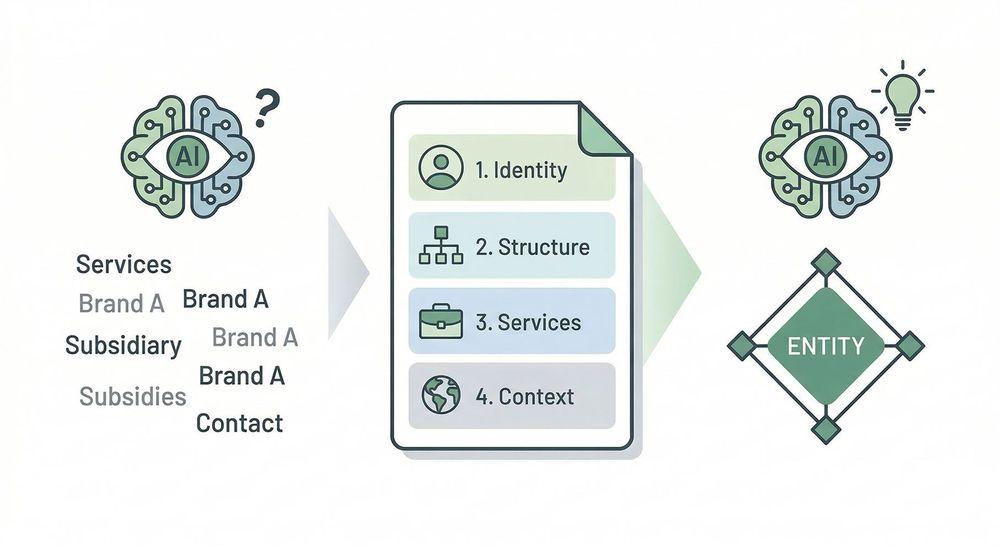
In this context, the term grounding page is appearing more and more often. It usually refers to a page that clearly and structurally explains a company, its role, its services, its responsibilities, and how it differs from similar brands or providers. That can be useful. But it is not a silver bullet. Anyone who simply builds a new page without putting the rest of the website, the brand structure, and the underlying SEO signals in order will usually see only limited benefit. A solid SEO foundation remains essential.
What Is a Grounding Page?
A grounding page is not an officially established SEO method, nor is it a guaranteed lever for visibility in AI systems. Put simply, it is a clear orientation page that answers key questions for both the system and the user: who you are, what you offer, who you work for, how your company is structured, and how you differ from similarly named brands or providers.
At its core, this kind of page brings together information that may already exist across your website and other directories, but is often scattered, inconsistent, or too vague. A good grounding page consolidates that information and presents it in a way that is easier for both people and machines to understand.
As mentioned, creating a grounding page is not yet an official SEO standard. At the same time, there are already early open initiatives such as the Grounding Page Project that aim to systematize such pages as structured reference and fact pages for AI. This shows that the topic is being discussed more concretely by experts. What still matters most, however, is whether companies present their brand, services, and responsibilities clearly and consistently.
Why Can Grounding Pages Be Helpful for AI Systems — and Which Companies Benefit Most?
AI systems rarely rely on just one section of text from a website. They combine signals from multiple sources, pages, and formats. Anything that clearly explains identity, context, and responsibilities can help. A grounding page can be useful precisely for that reason: it creates a central place where your company is described in a clear and concise way, instead of spreading important information across many subpages.
This kind of page is particularly useful for companies with a complex service portfolio, highly explainable offerings, ambiguous brand names, or historically grown company structures. This also applies to businesses that are regularly misunderstood or misclassified, for example because they are confused with other companies or because services and responsibilities are spread across multiple domains, brands, or subsidiaries.
Service providers, technology companies, industrial firms, and consultancies with specialized offerings often benefit as well. In these cases, a short homepage is usually not enough to clearly communicate market position, service scope, and differentiation. The more explanation a business requires, the more worthwhile a dedicated page for clear classification can become.
When an AI system builds an overall picture from scattered information, a well-structured page with facts, differentiation, and meaningful links is often more reliable than many isolated pieces of text spread across different places.
There is another aspect as well: AI models and search engines do not just benefit from keywords, but from entities. In other words, they need to recognize whether a company appears as a clearly defined unit with specific services, people, locations, brands, and relationships.
Why Grounding Pages Are Not a Silver Bullet
As useful as the concept may be, a single page does not automatically ensure that you will “rank in AI” or appear in AI Overviews. Any promise like that would be misleading.
A grounding page can help, but it does not replace a clean website structure, trustworthy content, verifiable references, technical accessibility, or consistent brand communication. If your website does not make it clear who the actual provider is, which services the main brand offers, what role subsidiaries play, or if the content consists mainly of marketing phrases instead of real substance and depth, an additional orientation page will do little or nothing to compensate for those weaknesses.
What Role Do Entities, Brand Understanding, and Clear Classification Play?
In B2B especially, the biggest obstacle is often not a lack of content, but a lack of clarity. Companies may have several services, differently named business units, a holding structure, or brands that have developed over time. This is not always easy for people to understand, and it is even harder for AI and search systems.
That is why a good grounding page should clearly answer questions such as:
- Who is the main organization?
- Under which brand do you operate?
- Which services belong to which organization?
- Who is the point of contact?
- Which subsidiaries or locations belong to the company — and which do not?
Brand differentiation is just as important. If your company name sounds similar to another provider, if several brands operate under one umbrella, or if individual subsidiaries have different roles, this should be stated explicitly. In that case, a grounding page is less an additional landing page and more a clean reference point for your digital identity.
Why Internal Linking, Context, and Trust Signals Matter
A good grounding page does not work in isolation. It needs to be embedded into the website. Internal linking is more than navigation. It shows relationships. The page should therefore be meaningfully connected to service pages, industry solutions, references, About Us content, contact information, and, where relevant, locations.
Context matters just as much. If a page states that a company is an expert in certain services, the relevant subpages should support that claim with actual content. If references are mentioned, they should be understandable and credible. If specific industry expertise is claimed, this should be demonstrated through case studies, projects, or content that provides real evidence.
Trust signals also belong here: a clearly identifiable company, real contacts, verifiable contact details, credible references, industry affiliation, certifications, or a coherent presentation of the company’s role in the market. All of this improves not only machine understanding, but also credibility for potential customers.
What Should a Good Grounding Page Include?
The exact structure depends on the company. In many cases, a good grounding page is strongest when it stays concise while still answering the most important classification questions.
This usually includes:
- a clear company profile
- an understandable description of core services
- differentiation from similar terms or brands
- information about the organizational structure
- a clear explanation of subsidiaries, business units, or locations
- structured facts such as company name, brand, headquarters, industry focus, and responsibilities
- contact persons or points of contact
- references or typical fields of application
- trust signals such as a Wikipedia entry, press releases, or social media profiles
- a useful FAQ section
What matters here is this: content should not only be well written, but also clearly structured. Clear headings, unambiguous statements, and logically organized information help users just as much as AI and search systems. Technical markup can support that clarity, but it cannot replace understandable content.
When Is an Existing About Us Page Enough?
Not every company needs a separate grounding page. In many cases, it is enough to refine an existing About Us page, company profile page, or service overview. That is often the better path. Additional pages only make sense if they truly close an information gap.
If your About Us page already explains your brand, services, responsibilities, structure, references, and contact points clearly, it may serve the same purpose. In many cases, the real solution is not a new page, but a clear editorial improvement of the existing core pages.
Conclusion: Grounding Pages Are Useful When They Create Real Clarity
Grounding pages can be a useful building block for visibility and citation potential in AI systems. This is especially true when companies need to clearly explain complex services, multiple brands, subsidiaries, or offerings that require more explanation. The real lever, however, is not simply the existence of an extra page, but the clarity of the website as a whole.
Companies that present their brand, services, and organizational structure clearly create better conditions for search engines, AI systems, and users alike. That is why the more relevant question is often not, “Do we absolutely need a grounding page?” but rather, “Is our company presented digitally in a way that both people and machines can clearly understand?”
If you’d like to determine whether a dedicated landing page would be beneficial for your business or if your existing website and brand structure could be refined, we’d be happy to assist you with a thorough analysis of your content and structure. Contact us today!
Attract customers with gravitational marketing!
We are experts in websites, shops, social media, SEO, Google Ads, web design, online marketing and much more. With our team, you will achieve more gravity on the Internet - call us today!
Get in touch now!